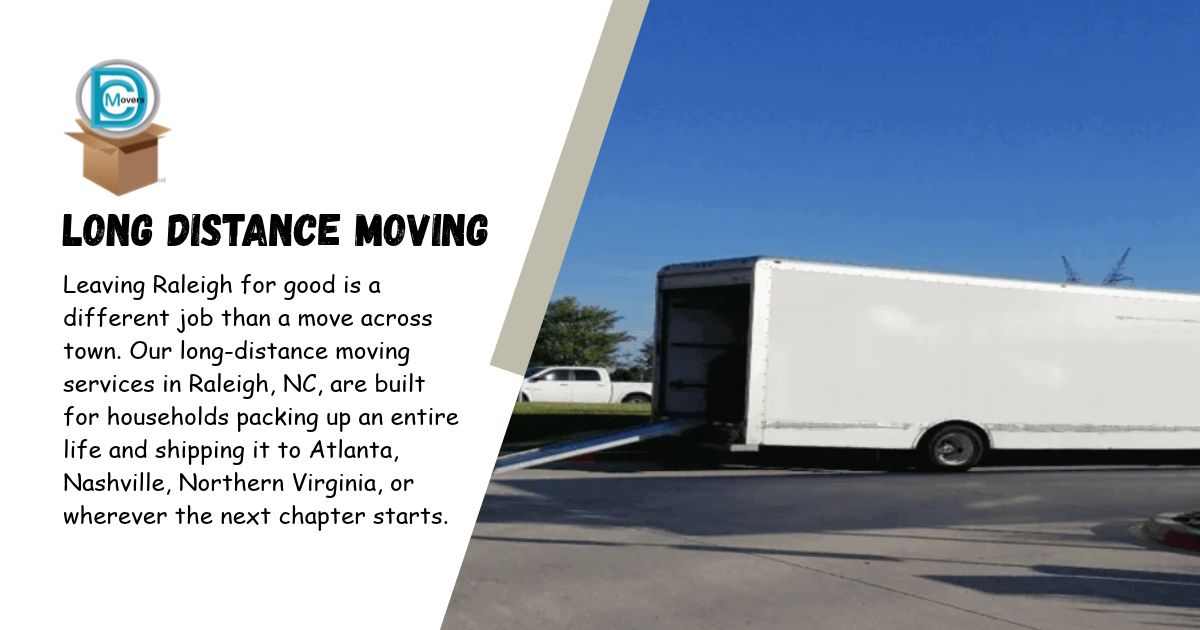
If you are leaving Raleigh for another state, or even for the far end of North Carolina, a long distance moving services in Raleigh, NC works differently from a local one. It usually involves a longer timeline, more planning, a larger truck load to organize, and pricing that depends on distance and weight or volume rather than a simple hourly clock. This guide explains what counts as a long-distance move, how the process works from estimate to delivery, what drives the price, how to prepare, and what to look for when you compare movers. It is written for households and small businesses relocating out of the Raleigh area who want a clear picture before they start calling around.
The short version: start earlier than you think you need to, get a written estimate based on a real inventory, confirm exactly what is and is not included, and keep valuables and paperwork with you instead of on the truck.
What Is Considered a Long Distance Move?
There is no single legal or universal cutoff that turns a move into a long-distance move. The definition shifts depending on who you ask, and that matters because it changes how your move is priced and scheduled.
Many moving companies treat a move as local when it stays within a fairly short radius, often around 50 miles, and as long-distance once it goes beyond that. Others reserve the long-distance label for moves of several hundred miles. Some companies also separate a long-distance move that stays inside one state from one that crosses state lines, because different rules and pricing structures may apply.
For someone in Raleigh, that spread of definitions has practical consequences. A move from Raleigh to Charlotte is a substantial drive across the state, roughly a few hours on the interstate, yet it never leaves North Carolina. A move from Raleigh to Wilmington or Asheville is similar in that sense. A move to Virginia, Georgia, Florida, or New York clearly crosses state lines and is handled as interstate. Whether a mover prices your Raleigh-to-Charlotte move by the hour or by a distance-based estimate depends on that company’s own policy, so it is worth asking directly rather than assuming.
A useful rule of thumb: if the truck will be on the road long enough that your belongings will not be delivered the same day, or if the crew cannot reasonably load in Raleigh and unload at the destination in one working shift, you are dealing with a long-distance move and should plan accordingly.

Long Distance vs. Interstate Moving: What Is the Difference?
People use these terms interchangeably, but they describe two different things.
Long-distance describes how far you are going. Interstate describes whether you are crossing a state line. A move can be one, the other, or both. A move from Raleigh to Charlotte is long-distance but intrastate. A short hop from a Virginia border town into North Carolina is interstate but not especially long. The difference matters for a few reasons.
First, regulation. Movers that cross state lines fall under federal oversight, and a mover carrying household goods across states is expected to be registered with the Federal Motor Carrier Safety Administration and to have a USDOT number. Moves that stay inside one state are handled under that state’s rules instead. If you are hiring for a state-to-state move, checking that registration is a sensible first step, and the federal government publishes a consumer guide called Ready to Move? that explains your rights and the paperwork you should expect.
Second, paperwork. Interstate movers generally provide written estimates, a bill of lading, and information about liability coverage. You should expect to review and sign these documents, and you should read them before moving day, not on the driveway.
Third, terminology in searches. If you type “interstate movers Raleigh,” “cross-country movers,” “state-to-state movers,” or “long-distance movers Raleigh” into a search engine, you are describing the same basic need from different angles. What separates a good result from a poor one is not the label the company uses but whether it can clearly explain how your specific move will be handled.
How Do Long Distance Moving Services Work?
Most long-distance moves follow the same general sequence, even though details vary by company.
Inventory and estimate
The process starts with a list of what you are moving. A reputable mover will want to know about your furniture, appliances, boxes, and anything unusual: a piano, a safe, a large sectional, gym equipment, artwork, or items stored in a garage or attic. Some companies do this through a video walkthrough, some send someone to your home, and some ask you to fill out a form. The more accurate your inventory, the more accurate the quote.
Written quote
You should receive a written estimate that explains how the price was calculated. Interstate estimates are commonly based on the weight or volume of the shipment and the distance, plus any extra services you request. Ask whether the estimate is binding, meaning the price is fixed for the listed items and services, or non-binding, meaning the final charge can shift based on actual weight or conditions. Neither is automatically wrong, but you should know which one you are getting.
Scheduling
Long-distance moves are scheduled around pickup and delivery windows rather than a single appointment. Your loading date, the transit period, and the delivery date may not be the same day. Ask what window you can expect at each stage and how the company will communicate if something changes.
Packing and loading
On moving day, the crew protects and loads your belongings. Furniture is typically wrapped or padded, and the load is arranged so that heavy items sit low and stable while fragile boxes are secured. How the truck is loaded matters more on a long trip, since items will be moving over highway miles for hours or days.
Transportation
Your belongings travel to the destination, sometimes on a dedicated truck and sometimes as part of a shared load, depending on the mover and the size of your shipment. Ask which applies to you, because it affects timing.
Delivery and unloading
At the destination, the crew unloads and places furniture and boxes where you direct them. This is the moment to check your inventory list against what arrives and to note any damage in writing before you sign off.
When Should You Hire Long Distance Movers in Raleigh?
Renting a truck and driving it yourself can work for a small apartment on a tight budget. For many long-distance moves, though, professional movers make more sense.
Consider hiring professionals when:
- You are moving to a full household, such as a two- or three-bedroom home or a larger place.
- You have heavy or awkward items like a sofa sleeper, dresser sets, a treadmill, or a piano.
- You cannot spare several days to load, drive, and unload on your own.
- You are relocating for a job start date and need predictability.
- You have stairs, a tight townhouse entrance, or an apartment with an elevator reservation window.
- You are worried about injuries or damage from handling heavy furniture on your own.
Do-it-yourself moves also carry hidden costs that are easy to overlook: fuel for a heavy truck, rental fees that add up by the day or mile, equipment like ramps and dollies, packing supplies, and your own time and physical effort. A quote from professional movers is not always more expensive than the total of these pieces once you count everything honestly.
Local context helps here too. Raleigh’s spring and summer moving season is busy, and heat and humidity can make loading a truck exhausting. Sudden thunderstorms and, in winter, the occasional icy morning can also affect timing. If you have flexibility, a weekday move outside the busiest weeks at the end and start of each month is often easier to schedule.
What Services Can Long Distance Movers Provide?
The services offered vary from company to company, so treat the list below as a set of questions to ask instead of a promise about any single mover.
Loading and unloading
The most basic service is having a crew load your belongings in Raleigh and unload them at the destination. This is the core of many long-distance moves and is where trained labor makes the biggest difference.
Packing services
Some movers pack everything for you, some pack only fragile or specialty items, and some leave packing to you entirely. Full packing saves time but adds to the cost. Partial packing, such as having professionals pack dishes, mirrors, and artwork while you handle clothing and books, is a common middle path.
Furniture protection
Furniture is usually covered with moving blankets, shrink wrap, or pads to protect finishes and upholstery. Ask about disassembly and reassembly of beds, tables, and large shelving, since taking furniture apart often makes it safer to move.
Storage
Sometimes your new home is not ready the day your belongings arrive. Some moving companies offer short-term storage or can coordinate with a storage facility. If this could apply to you, ask about it early because it affects delivery scheduling and cost.

Residential and commercial moves
A residential move might involve an apartment, condo, townhouse, or house. A commercial or office move brings other considerations: desks, filing cabinets, computers, server equipment, and downtime. If you are relocating a small business, ask how the mover schedules around business hours and how they handle IT equipment, since standard furniture blankets are not always enough.
Specialty and bulky items
Pianos, safes, large televisions, and antiques often need special handling or equipment. Mention these during the estimate rather than surprising the crew on moving day, since a late discovery can change the price and the truck plan.
How Much Does Long Distance Moving Cost From Raleigh?
Anyone who quotes you a flat “average price” without knowing your inventory and destination is guessing. Long-distance moving costs are shaped by a handful of factors you can control or at least understand.
Distance. A move to Charlotte costs less than one to Miami or Dallas because the truck spends less time on the road and uses less fuel. Distance is one of the biggest inputs in interstate pricing.
Weight or volume. The more you move, the more you pay. A studio apartment and a five-bedroom house are priced very differently. One of the most effective ways to lower your quote is to reduce what you take, which is why decluttering before an estimate can save real money.
Time of year and day of week. Late spring through summer is peak moving season across the country, and the first and last days of the month tend to be especially crowded. Booking in off-peak periods or midweek can sometimes make pricing and scheduling easier.
Services requested. Packing, unpacking, disassembly, storage, and specialty item handling are typically priced separately from basic loading and transport.
Access conditions. Stairs, long carries from the door to the truck, elevators, narrow hallways, and difficult parking can add time and labor. If the truck cannot park near your entrance, tell the mover ahead of time.
Fuel and other charges. Ask whether fuel, tolls, or fees for extra stops are included or billed separately.
Insurance and valuation coverage. Carriers offer different levels of protection. The default coverage on many interstate moves is based on weight and is quite limited compared with the actual value of most households, so ask what is included and what higher coverage would cost.
Estimate versus quote
People often use the terms interchangeably, but a careful reader should ask how the number was produced. An estimate based on a video walkthrough or in-home survey is usually more reliable than a number given after a two-minute phone call. If two companies are far apart in price, compare their inventories first. The lower quote may simply be assuming fewer items.
Watching for red flags
Be cautious if a company offers a price far below every other quote, asks for a large cash deposit upfront, refuses to put anything in writing, or will not tell you its USDOT number for an interstate move. Reasonable pricing is transparent, written, and explained.
How to Prepare for a Long Distance Move
A long-distance move rewards early preparation. Here is a practical timeline you can adapt.
Six to eight weeks before
- Start collecting quotes and comparing what each includes.
- Decide what you are taking. Sell, donate, or discard what you do not want to pay to move.
- Tell your employer, landlord, or property manager about your move date, and reserve elevator time if you live in an apartment.
- Start using the pantry, freezer, and cleaning supplies.
Three to four weeks before
- Confirm your mover, dates, and written estimate.
- Begin packing rooms you rarely use, such as guest rooms and storage closets.
- Gather and label important documents, and arrange transfers for school and medical records.
- Update your address with banks, insurers, subscriptions, and government agencies.
One to two weeks before
- Finish most packing. Label each box with the room and a short description of the contents.
- Photograph valuable furniture and electronics, including serial numbers where relevant.
- Arrange utilities shutoff and start dates at both addresses.
- Set aside an essentials bag for the first night at the new home.
Moving day
- Walk through the home with the crew to point out fragile pieces and items that should not be loaded.
- Confirm the inventory list and the delivery window before the truck leaves.
- Keep your phone charged and your contact details accurate.
What to pack and what to leave out
Pack clothing, books, kitchen items, and decor in sturdy boxes with proper tape. Use smaller boxes for heavy items like books and larger boxes for lightweight items like linens. Disassemble what can be safely disassembled, and keep hardware in labeled bags taped to the furniture piece.
Items to keep with you rather than put on the truck usually include important documents, medications, jewelry, laptops, chargers, and anything irreplaceable. Movers also commonly will not transport certain hazardous items such as propane tanks, gasoline, cleaning chemicals, paint, and aerosols, so ask for a list of non-allowables in advance.
A note on furniture and fragile items
Furniture that travels several hundred miles faces more vibration, more handling, and more time in the truck. Wrapped and padded pieces travel better than those left bare. Glass tabletops, mirrors, and framed artwork are best packed in dedicated boxes or crates. Take photos of your furniture before the move so that any damage claim has a clear reference.
How to Choose a Long Distance Moving Company in Raleigh
Picking movers is the decision that most affects how the rest of your move goes. Use these questions as a checklist.
Are they properly registered? For interstate moves, look for a USDOT number and confirm it through the federal motor carrier database. For moves within North Carolina, ask about state requirements and licensing.
Do they inspect your inventory? A company that gives a price without asking what you own is not giving you a real number.
Is the quote written and detailed? It should list services, charges, and what is excluded.
What is the coverage? Ask about liability protection, what happens if an item is damaged, and how claims are handled.
Who does the work? Ask whether the crew members are employees or subcontracted, how many people will be on the truck, and how the company handles a delay or breakdown.
How do they handle communication? You should know who to call during transit and how often you will get updates.
What do previous customers say? Read reviews across several platforms and look at how the company responds to complaints. A few negative reviews are normal. Patterns of unexplained fees, missed delivery windows, or damaged items are worth noticing.
Can they explain the process in plain language? A company that is confident in its process will explain each step without pressure.
Comparing more than one written quote is worth the effort. Put the inventories side by side, check what each includes, and ask about any gaps before deciding based on price alone.
Common Mistakes to Avoid During a Long-Distance Move
Many problems in long-distance moves come from the same handful of avoidable mistakes.
Booking too late. Waiting until the last two weeks limits your options and can push you into less convenient dates or higher prices.
Underestimating what you own. Garages, sheds, attics, and closets hold more than most people remember. Undercounting leads to a low quote that grows later.
Choosing purely on the lowest price. A very low number sometimes reflects missing services, unrealistic weight assumptions, or a company that plans to adjust the price after loading.
Skipping the paperwork. Signing without reading the bill of lading, the inventory list, or the valuation options can leave you with little recourse if something goes wrong.
Packing badly. Overloaded boxes, poor tape, and unlabeled cartons cause damage and slow down unpacking.
Forgetting access details. Not mentioning a long driveway, stairs, or an apartment with restricted moving hours can change the crew size and time needed.
Leaving valuables on the truck. Keep documents, jewelry, medication, and electronics you cannot replace with you.
Not planning for the delivery window. Be ready to receive your belongings, and have someone who can direct the crew and sign paperwork on arrival.
Common Routes and What to Expect
Raleigh’s position along Interstate 40, Interstate 85, and Interstate 95 makes it a convenient starting point for many long routes. Common destinations include Charlotte and other parts of North Carolina, Virginia, Georgia, Atlanta, Florida, Texas, and the New York area. Each has slightly different considerations: traffic and toll roads in the Northeast corridor, longer transit for cross-country routes to Texas or beyond, and heat or storm conditions in southern destinations during summer.
You do not need a separate mover for each route. What matters is that the company can explain how your specific route affects timing, cost, and delivery. If you are moving to a place that is hard to reach, such as a dense city with limited truck access, mention it up front.
Conclusion
A long-distance move out of Raleigh is easier when you understand how it works before you start: what counts as long-distance, how interstate rules differ, what drives the price, and what to ask before you sign. Get a written estimate based on a real inventory, confirm what is and is not included, prepare early, and keep the paperwork and valuables close. If you would like to talk through your route, timing, or inventory with a local crew, call DC Movers at (919) 519-1715.
FAQs
What is considered a long-distance move in Raleigh?
There is no universal cutoff. Many companies use roughly 50 miles as the dividing line between local and long-distance, while others use several hundred miles, and a move that crosses state lines is typically treated as interstate regardless of length. Ask any mover how they define it, since that affects how your move is priced.
What is the difference between long-distance and interstate moving?
Long-distance refers to the distance traveled, while interstate refers to crossing a state line. A Raleigh-to-Charlotte move is long-distance but stays in North Carolina. A move to Virginia is interstate. Interstate moves involve federal registration and additional paperwork.
How far in advance should I book long-distance movers?
Six to eight weeks ahead is a comfortable window for most households, and earlier is better in summer or at the end of the month. If your move date is fixed, such as a job start or lease end, book as soon as you have one.
How long does an interstate move usually take?
Transit time depends on distance, route, and whether your belongings travel on a dedicated truck or a shared one. Loading and delivery may happen on different days. Ask for written pickup and delivery windows rather than a single promised date.
Do long-distance movers pack and unpack furniture and boxes?
Many do, but not all. Some offer full packing, some pack only fragile items, and some only load what you have already packed. Confirm exactly what is included in your quote, and ask about unpacking and furniture reassembly if you want that service.
Can long-distance movers provide storage during a move?
Some can, either through their own facilities or by coordinating with a storage provider. It is useful if your new home is not ready for delivery. Raise it during the estimate so it can be built into the schedule and price.
What should I not pack for a long-distance move?
Movers commonly will not carry flammable or hazardous items such as gasoline, propane, paint, aerosols, and many cleaning chemicals. Keep important documents, medications, jewelry, and valuable electronics with you. Ask your mover for a written list of non-allowable items.